Arthur and Sherlock by Michael Sims
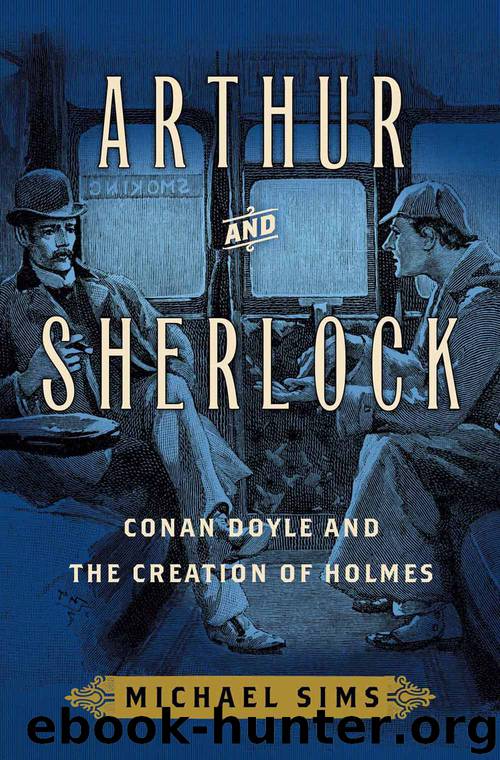
Author:Michael Sims
Language: eng
Format: epub
ISBN: 9781632860385
Publisher: Bloomsbury Publishing
Published: 2016-11-07T05:00:00+00:00
* * *
One notable contrast between Arthur’s detective duo and Poe’s is exemplified by how they meet. Dupin and his narrator bump into each other while seeking “the same very rare and very remarkable volume” in “an obscure library in the Rue Montmartre.” The two men are barely in and of the world. Despite Dupin’s emphasis on reason and evidence, they exist in a murky, candlelit landscape familiar to readers of Poe’s Tales of the Grotesque and Arabesque.
In contrast, Arthur opened Chapter 1 of A Study in Scarlet with Dr. Watson seeking affordable lodgings. Young, wounded, exhausted, and of a naturally modest disposition, he seems to stride out of the real world in a way that Poe characters never manage.
Poe was born in 1809 and died at the age of forty, a decade before Arthur’s birth. His natural bent was Romantic and Gothic. In Edinburgh half a century down the literary road, Arthur grew up reading Mayne Reid melodramas of the American western frontier—and reading Edgar Allan Poe. Later, as he sat at his Southsea desk in the mid-1880s and conjured Sherlock Holmes and Dr. Watson, his imagination naturally returned to the work of one of his favorite writers, and to the analytical detective who had intrigued him since boyhood. By this time, however, Arthur was influenced by plainspoken, more realistic adventure writers who eschewed Poe’s cobwebs. He admired, for example, his fellow Scot Robert Louis Stevenson and the American Bret Harte. And his admiration showed in his work; in 1884 at least one Cornhill reader had attributed Arthur’s own “J. Habakuk Jephson’s Statement” to Stevenson, and Arthur had written stories such as “The American’s Tale” in imitation of Harte’s tales of gold rush mining towns on the American frontier.
In creating his own detective, Arthur would naturally recast Dupin’s influence in his own later, less Romantic era. He also drew from the real-world inspiration of Dr. Bell, who strode among suffering patients, noting their occupational scars and mud-splashed boots—and weaving from such seemingly unrelated clues a narrative of their lives. Poe was knowledgeable about the natural and theoretical sciences, as his wide-ranging essay “Eureka” and other works demonstrate, but he did not endow his detective with a scientific approach to crime-solving. Borrowing from Voltaire, he gave Dupin a playful kind of observant genius that lends itself to the logical deciphering of puzzles.
Poe had not had the good fortune to study with Joseph Bell. He could assign Dupin a theory of observation, and he could detonate verbal fireworks about logic. But apparently Poe himself did not have the trained observational skills to bestow upon his brainchild. Arthur did. He was no detective himself, but he had witnessed such talents at work. Years of training with one of the most acclaimed diagnosticians of his time had left Arthur aware that such insight was not only possible but an art and science that one could cultivate.
Sherlock Holmes, in contrast to Dupin, embodies Arthur’s faith in science as both an instrument of progress and an intellectual adventure.
Download
This site does not store any files on its server. We only index and link to content provided by other sites. Please contact the content providers to delete copyright contents if any and email us, we'll remove relevant links or contents immediately.
Cecilia; Or, Memoirs of an Heiress — Volume 2 by Fanny Burney(32086)
Cecilia; Or, Memoirs of an Heiress — Volume 3 by Fanny Burney(32063)
Fanny Burney by Claire Harman(26721)
We're Going to Need More Wine by Gabrielle Union(19167)
Plagued by Fire by Paul Hendrickson(17535)
All the Missing Girls by Megan Miranda(16689)
Cat's cradle by Kurt Vonnegut(15553)
For the Love of Europe by Rick Steves(14901)
Bombshells: Glamour Girls of a Lifetime by Sullivan Steve(14216)
Leonardo da Vinci by Walter Isaacson(13506)
4 3 2 1: A Novel by Paul Auster(12609)
The remains of the day by Kazuo Ishiguro(9218)
Adultolescence by Gabbie Hanna(9020)
Note to Self by Connor Franta(7747)
Diary of a Player by Brad Paisley(7717)
Giovanni's Room by James Baldwin(7540)
What Does This Button Do? by Bruce Dickinson(6314)
Ego Is the Enemy by Ryan Holiday(5617)
Born a Crime by Trevor Noah(5488)
